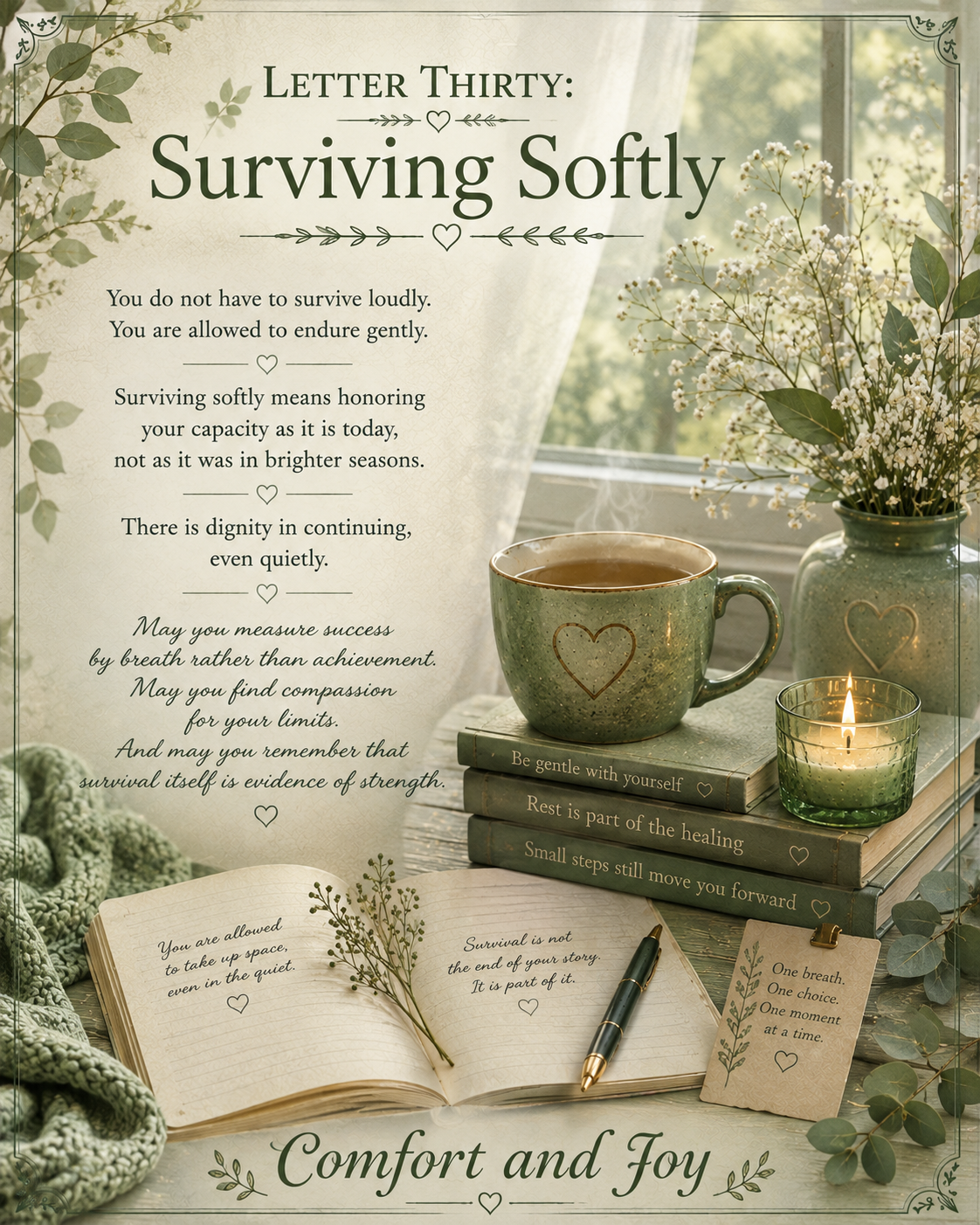
Letter Thirty: Surviving Softly

Dear Friends,

There are seasons when thriving feels distant, and simply surviving becomes the work of the day. Survival does not always look heroic. Some days, it may look like getting out of bed when grief presses heavily against your ribs. On others, it may mean answering one message instead of ten, preparing something simple to eat, or allowing the laundry to wait until tomorrow. There may even come a time when choosing rest instead of pushing harder is the bravest decision you make all day.

You do not have to survive loudly. You are allowed to endure gently.

There is a tendency to judge ourselves most harshly when we have the least to give. We remember the person who once managed everything and wonder where that person has gone. We measure today’s strength against yesterday’s capacity and mistake the difference for failure. Yet you are not failing.

Surviving softly means honoring your capacity as it is today, not demanding that it resemble what it was in brighter seasons. It means understanding that strength changes shape. Sometimes strength builds, carries, solves, and accomplishes. Other times, strength closes the door, makes a cup of tea, and decides that tomorrow is soon enough to try again.

There is wisdom in knowing the difference between surrendering and setting something down because your hands need rest. Perhaps that is one of the hardest lessons of difficult seasons: your worth does not diminish when your capacity does. You remain worthy of love when you are exhausted and when you are struggling to find your way. And this season is not your identity. The person moving slowly today still carries dreams. The heart that feels weary still remembers hope. Beneath the surface, something in you continues to endure, even when you cannot yet imagine what the next chapter will look like.

This week, if you find yourself in survival mode, treat yourself with extraordinary kindness. Make the day smaller if you need to. Take one thing at a time. Let enough truly be enough. There is dignity in continuing, even gently.

May you measure success by breath rather than achievement.
May you find compassion for your limits.
May you trust that rest does not erase your progress.

With tenderness,
Comfort and Joy

Letter Twenty-Nine: Strength That Looks Like Tenderness

Dear Friends,

We were taught that strength is rigid. That it stands tall, unshaken, and unbending. That it carries without complaint and perseveres without tears. Our grandparents called it backbone; our parents called it grit. Yet there is another kind of strength—quieter, softer, and often overlooked. It is not the thunder, but the stillness after a storm. It is the strength that says, “I don’t know,” and chooses kindness when anger would be easier. Other times, it is the strength to love even as your hands tremble, or to hold a door open for someone walking away from you forever.

Tenderness is not weakness. It is the tenacity to care even when that care is unreturned, the patience to listen when you would rather shout. It is the discipline of forgiving and the stubbornness of hope. Sometimes, it is the strength to let go—to set down the impossible expectations, to mourn what you cannot fix, and to leave the party before the last guest has gone.

We are not taught these lessons in school. They are learned in the quiet hours—at hospital bedsides, in the hush after a funeral, or in the slow mend of a broken friendship. They are learned in therapy waiting rooms, in small acts of kindness, and in the honesty of late-night conversations. The world will not pin a medal on you for surviving another day with your heart intact, but that is the true triumph: to remain gentle with yourself and others in a culture that mistakes cruelty for confidence.

This week, I hope you will see your own strength with new eyes. Trace its outline not just in your victories, but in your kindness, your capacity to forgive, and your willingness to feel. When you catch yourself reaching for your old armor, pause. Ask what would happen if you faced the day unshielded and let your emotions have their say. Notice how your compassion has carried you farther than force ever could. Remember the times your softness protected someone else, or yourself, from a sharper edge.

Let your tenderness be its own kind of protest, a quiet resistance to the myth that strength must always be harsh. Honor the parts of you that are still healing, still learning, and still willing to begin again. May your softness be honored. May your strength feel humane, not hardened. And may you trust that a soft heart can still be steady.

With warmth,
Comfort and Joy

Letter Twenty-Eight: Learning to Receive Care

Dear Friends,

We are taught from our earliest days to value generosity, to be the one who extends a hand, offers advice, steadies someone else in their hour of need. The impulse to give flares up proud and bright inside us, sweetened by admiration and the comfort of being useful. We offer rides. We cook meals. We listen, nodding, as a friend retraces the same heartbreak for the tenth time in a single week, and we do so gladly, happy to be the calm coastline to someone else’s storm. Sometimes it feels like a shield—a way to stave off our own needs and to escape the vulnerability of being seen as less than whole.

We are told to be the friend who checks in, the partner who anticipates needs, the colleague who carries the extra load. There is a script for these roles, and it is easy to find our place on the stage. Yet there is another side, one that is less rehearsed, less public, and trickier to play: the act of receiving. To receive care, true and unguarded, is to let something soft and unmanageable rise within you. It is to admit, if only to yourself, that you are tired. That you have run out of solutions. That your patience, courage, or heart has reached a silent edge. It is to take the outstretched hand, not just because you are polite, but because you need it, and to trust—perhaps for the first time—that someone will not let you fall.

Letting yourself be cared for is humbling. It means allowing someone else to witness your less capable moments, to see intricacies of your struggle you would rather keep hidden. You must believe not only in the kindness of others but in your own worthiness of that kindness; that belief often trembles and rattles precariously on the shelf. The idea of burdening someone with your weight feels almost intolerable. You might fear that accepting help will diminish you in the eyes of those you love. That it will leave a mark, a tally of debts you can never fully repay.

But none of this is true.

You are allowed to be supported. You are allowed to accept help without earning it first. You are allowed to lean on someone without apology. The fabric of relationship is not made brittle by reciprocity, but rather by the mutual movement of care, passed gently back and forth like a wordless lullaby.

To receive is not to become less generous, less brave, less yourself, but to open another door to intimacy and let your life be reflected in the mirror of someone else’s concern. Receiving care does not diminish your strength. It deepens your humanity.

This week, if someone offers kindness, resist the urge to deflect it. Let the meal be cooked for you. Let the compliment land. Let the listening happen without interruption.

May you feel safe enough to receive.
May your heart soften in shared strength.
And may you discover that belonging includes being cared for, too.

With gentleness,
Comfort and Joy

Letter Twenty-Seven: The Safety of Familiar Hearts

Dear Friends,

There is a kind of healing that exists only within familiar hearts. These are not merely people who have learned your laugh or your middle name or the shape of your particular sadness. These are the ones who remember the precise tilt of your world when you were twenty and reckless, or thirty and trying very hard to pretend you do not still bruise so easily. They have seen your worst days with the lights on, and somehow, with the same attentiveness, they chose to stay.

Familiar hearts are not always loud; sometimes they are a cup of coffee placed at your elbow before you wake, a text at 2 a.m. asking if you are okay. They are the hearts who know your cycles of mood and your calendar of grief. They are the ones who never make you beg for understanding, do not keep a ledger of your faults, and believe in you with a clarity that sometimes feels like the only true thing in the room.

These are the hearts that create a soft place to land, not because they fix the sharpness of life around you, but because they are a witness to your living. If you have ever spent time in a cold house or a city where you knew no one, then you know the relief of returning to a place where your name is not a question but a greeting. Familiar hearts provide the kind of safety that is not the absence of hardship, but the assurance that, whatever comes, you will not be asked to carry it alone.

You can tell you are in the presence of a familiar heart because your voice is unmodulated, your flaws uncomplicated, and your hunger for affirmation momentarily sated. You remember the version of yourself who existed before all the caution. If you have even one such relationship—a friend, a sibling, a lover, a dog—consider yourself wealthy.

It is easy to underestimate the rarity of these relationships. The world trains us to keep our defenses high, to present a curated self, and to believe that intimacy is always conditional, always a performance. But familiar hearts are proof that there are places where pretense is unnecessary, where loyalty is not earned but given freely, where forgiveness is reflexive, not calculated. These bonds may not look extraordinary from the outside; they may be built on decades of mundane Tuesdays and inside jokes and the endless repetition of “I’m here.”

Maybe you are the person who opens your home to others, keeps the porch light on and the kettle ready. Maybe you are the one others turn to when everything else falls apart. If so, know that this is not small work. It is heroism.

This week, let yourself reach for the familiar hearts in your orbit. Text the friend you haven’t seen in too long, say “I love you” to the parent who doesn’t always say it back, let someone make you dinner without apologizing for the state of your kitchen. Let yourself be cared for, even if you are used to being the caretaker. Let yourself be held up, even if only for a moment. And if you are becoming that steady heart for someone else, if you are learning the art of showing up even when it is inconvenient or unglamorous, know that you are building something indestructible. You are a living antidote to the loneliness that plagues so many. You are a home, and a harbor, and a shelter in the storm.

May you recognize, even in the quietest moments, the incomparable gift of familiar love. May you nurture it with the gentlest hands. May you never mistake its steadiness for insignificance. And may you always, always find refuge in the hearts that know you best.

With warmth,
Comfort and Joy

Letter Twenty-Six: Love That Shows Up Quietly

Dear Friends,

Not all love is dramatic. Rarely does it crash down on us fully formed. Sometimes, love is a whisper, a murmur. Sometimes it arrives as a tide, patient and enduring, its ever-returning certainty eroding the sharp edges of loneliness. The truth is love manifests in ways so quiet we mistake it for the background hum of living.

It is in the person who notices when you have vanished into yourself, who finds you in your silence and, rather than forcing you out, sits quietly at the threshold of your self-imposed exile. It is in the person who knows your oddest rituals—the order in which you eat an orange, the song you play when you are sad, or the way you stack your pillows at night. It is the one who notices when the light in your eyes has dulled, then returns it with laughter or the simple gift of their undivided attention.

This love will not make headlines. It will not sweep you off your feet or leave you breathless. It will simply be there, steadfast and unglamorous. It is the friend who texts merely to say they read a poem that reminded them of you, the parent who leaves the porch light on when you are late, the partner who washes the mug you always forget in the sink, then sets it right-side up on the counter because they know you hate it when the rim touches the surface.

We are told to seek love in declarations, in magic, in the tumult of newness. We learn to measure it by standards of extravagance—by how much, how loudly, and how often. But when the fireworks pass, what remains are the forms of love that persist in silence. The love that lingers at the edges of your exhaustion. The love that forgives and forgives again, never tallying the score.

Love is the person who chooses to stay when leaving is an option. It is the friend who walks beside you even when the journey is neither brief nor easy, who slows their pace so you can keep up. It is someone remembering your birthday because the date is engraved somewhere inside their rib cage.

This week, try to notice the small ways love enters your orbit. Maybe it is a dog nuzzling your calf or a child offering a dandelion. Maybe it is simply the continuity of someone showing up, again, with no agenda but your well-being.

May you learn to recognize love in its most basic forms—the understated, the wordless, the steady. May you find yourself both the recipient and the giver of care. And may you come to trust, even in the absence of spectacle, that the love which endures is the love that matters most.

With tenderness,
Comfort and Joy

Letter Twenty-Five: Being Known Without Explaining

Dear Friends,

There is comfort in being known without needing to explain yourself. To sit across from someone who understands the cadence of your pauses. Your half-formed sentences do not fall away; instead, they are gently gathered, completed with a precision that is both startling and soothing, as if the other person has been keeping watch over the scattered parts of your story, piecing them together in the soft, patient work of their own heart. Your silences are places where neither of you feels the pressure to fill the emptiness, where being together is its own answer.

So much of the world requires explanation. Every day we explain our boundaries, as if the need for space or stillness were an offense that required protection. We defend our choices, as though autonomy were a luxury, not a birthright. Emotions must be clarified, caged into words that others can safely receive. To live in the world is, in some ways, to be perpetually cross-examined by it. Every softening is a calculated risk; every vulnerability is new evidence entered into the record. Even among those who wish us well, there is often the subtle pressure to perform, to present a self that is tidy and clear.

In the presence of true connection, you are allowed to be as you are: open, unguarded, a little bit wild. You do not have to rehearse your lines, monitor your own strangeness, or worry about which version of yourself is the most acceptable to the room. All the impulse to categorize or correct falls away, and you are, for a rare and precious moment, simply received. You can laugh loudly, mourn deeply, hold opinions that contradict themselves before the ink is dry—all of this is not just allowed, but understood, perhaps even cherished. The person before you recognizes the shape of your days, the recurring motifs of your sadness and joy, the reason for your longing. They see you, with all your unfinished business and inconvenient intensity, and do not shrink from it.

If, in the vastness of your life, there is even a single place or person where you are not required to translate yourself, that is a sacred soil in which the deepest roots of your being can anchor. To be truly seen is not a rare genetic gift, but a skill that can be cultivated—beginning, perhaps, with the willingness to extend such grace to yourself. The first home of belonging is often the one you build within, the voice that meets your own uncertainties with patience, forgives the ways you fall short of your imagined self, and honors the full mess of your existence.

This week, practice showing up as you are. Notice who or what invites you to soften, who receives you with an openness that does not immediately ask you to explain or amend. Pay attention to the moments and places where your need to prove diminishes, where the air grows easier to breathe. It is in these pockets of ease that the soul recalibrates, that you remember what it feels like to be held rather than managed.

May you be known gently.
May your presence be received without condition.
And may you find belonging in spaces that feel like home.

With warmth,
Comfort and Joy

Letter Twenty-Four: When Everything Falls Away

Dear Friends,

Some days, belief feels strong and certain. Other days it feels like glass, easily shaken and cracked. Yet a fragile belief is still a belief. You do not need unwavering confidence to be faithful. You do not need to silence every question to be steady. Sometimes belief is simply the act of holding on quietly, even when doubt sits beside you.

I once knew a man who lost almost everything. In the span of a few difficult years, he lost his home, his career, and the life he had carefully built. The routines that once gave his days structure disappeared, and the future he had imagined dissolved before his eyes. Along with everything else, his confidence in tomorrow began to crumble.

At first, anger became his closest companion. He blamed the economy, his circumstances, the people who had abandoned him, and sometimes even himself. He fought every disappointment as though sheer determination could force life to return to what it had been. But no matter how hard he pushed, each new beginning seemed to end in another closed door. What hurt most was not the loss of money but the disappearance of people he had once called friends. When success surrounded him, his phone rarely stopped ringing. There were invitations to dinners, celebrations, and business gatherings. People sought his advice, welcomed his generosity, and enjoyed the confidence that success seemed to bring. When hardship arrived, the silence was startling. The friends who once checked on him no longer remembered his number. Colleagues whose burdens he had gladly carried suddenly had no time to answer a message or return an email. Invitations ceased. Conversations faded. It was as though he had slowly become invisible.

For a long time, he believed his greatest loss was everything that had been taken from him. Then one morning, he realized something unexpected. He had spent months waiting for someone to rescue him, to offer an opportunity, to recognize his worth, or to remind him that he still mattered. But no one came. As painful as that realization was, it became the turning point of his life. He stopped asking why others had left and began asking who he wanted to become. He read books that challenged the way he thought, learned new skills, and accepted humble work without shame, understanding that honest labor carries dignity regardless of the title attached to it. Every day, he took one small step forward. Some days that meant sending another job application. Other days, it meant learning something new, exercising, journaling, or refusing to surrender to bitterness.

Slowly, he discovered that circumstances cannot take away confidence built from within. He no longer measured himself by applause, promotions, or popularity. He learned to enjoy his own company. He found peace in slow mornings, strength in discipline, and purpose in becoming someone he could respect, even when no one was watching. Years later, opportunities returned—not because he chased approval, but because he had become a different man. New friendships grew, rooted not in what he owned but in who he had become. He welcomed them with gratitude, yet he no longer depended on them for his sense of worth.

The world may change. Fortune may come and go. People may enter your life for a season and quietly leave. But the character you build, the wisdom you earn through hardship, and the confidence that grows from trusting yourself—these are treasures no loss can take from you. It was okay if his faith felt smaller than it once did. It was okay if his hope flickered. Even a candle flame trembles in the wind, yet it continues to burn. What mattered was not the size of his belief, but his willingness to protect it gently.

This week, treat your fragile faith with compassion. Shield it from harsh comparison. Nurture it with reflection. Allow it to be human.

May your belief strengthen in its own time. May your questions lead you deeper, not farther away, and may you discover that even fragile faith can sustain you.

With warmth,
Comfort and Joy

Letter Twenty-Two: Hope is a Daily Practice

Dear Friends,

Hope is often misunderstood as a sudden burst of optimism, a dramatic shift in circumstances, or a miracle that changes everything overnight. Hope is not a single-act play but a long-running series of mundane performances. No applause, no critics. Only the actor, the script, and the stage of everyday life. In this way, hope is a practice—less an achievement than a discipline to be honed. It is sitting at your cluttered desk, staring down a blinking cursor, and typing the words anyway. It is reapplying for the job you lost, or cracking open a fresh notebook after the last one filled up with failed plans. It is choosing to attend the family dinner, even though anxiety knots your stomach, because you know that sitting together at the table is a promise to try again.

Hope is the decision to give your child a gentle answer, when impatience sings like a migraine in your skull; to water the wilted basil plant even though it seems too far gone; to return one small act of generosity to a world that, lately, feels more barren than abundant. Each of these gestures is tiny, a small flicker of warmth against the chill of cynicism. Yet together, they form the backbone of endurance.

But the truth of hope, as quiet as it is, rarely draws attention to itself. It functions more like a river’s persistent erosion, barely noticed until you realize the canyon that’s been carved over years. These choices rarely earn recognition, yet they become the scaffolding that supports a meaningful life.

Imagine yourself on a Tuesday morning, before the sun has fully brightened the sky, standing in your kitchen, hands curled around a chipped mug. You are tired. Your bones hold the fatigue of yesterday’s disappointments, and your inbox is brimming with unanswered demands. If you listen closely, you can hear the drowsy shuffle of your kids getting ready for school or the low drone of the city waking up outside your window.

In that moment, you have a choice—the same one you made yesterday, and the one you will make tomorrow. You decide to meet the world’s indifference with a small, practical kindness, even if on difficult days, hope may feel thin as a thread. That does not make it weak because even the thinnest thread can hold remarkable strength when woven consistently.

This week, practice hope. Keep showing up to your own life with a flicker of willingness.

May your hope be steady rather than spectacular. May it root itself quietly in your heart, and may it carry you forward, one small step at a time.

With kindness,
Comfort and Joy

Letter Sixteen: Blooming in Your Own Time

Dear Friends,

There is confidence in a flower that blooms exactly when it was meant to—neither earlier nor later, regardless of the garden around it. While some petals unfold the instant the frost recedes, trembling to meet the sun, others linger, accumulating the patience of an entire season before daring to break open. You might see this as stubbornness or fragility, but it is, in truth, the strength only found in the ones who wait.
You, too, are allowed your own timing. Imagine the world as a field of blooms that opens only in the hush of darkness. There is no chart, no calendar, no gardener’s ultimatum dictating which will bloom first or how long any must wait. So it should be, and so it is with us: the hour and manner of our opening is ours alone to honor.
Comparison tempts us to measure our lives by someone else’s milestones. But blooming is not a race. Some lives burst into color early. Others gather wisdom and depth before they unfold. In the world’s noisy parade, there will always be those who seem to stride ahead—careers lighting up with the speed of sunrise, love stories unfurling before high school has even ended, wisdom teeth arriving on time and with no fuss. It is tempting to see them and feel the weight of your own unopened petals—a sense that you have failed, missed, or forgotten some cosmic appointment. You may stand in the shadow of brighter blooms and imagine your own season has passed unseen.

What matters is not when you bloom—but that you do. The late bloomers, the hesitant, the determined, are no less radiant for their patience. Their roots are, if anything, deeper for it, their stems more resistant. Your day will come—perhaps in a sun-drenched moment you less expect, or perhaps in a rain that makes nonsense of all plans. You will open, and the world will not have known it needed your fragrance until the instant you arrive.
You are not behind, too late or forgotten. There is a generosity to nature’s calendar. The daffodil does not lament the cherry’s slow blossom; the rose is not diminished by the quiet waiting of the hydrangea. Each stands where it is planted, trusting that its moment will arise, the warmth will reach it, the bees will find it, and its presence will matter. The world is not a stage that closes after the first act; the applause will be waiting, even if you enter long after the overture.
Every experience, delay, and preparation is shaping the petals you will one day open. The hours you spend in darkness are not wasted; they are nutrients, fortifying you for a bloom that will startle even your own memory. The setbacks, the redirections, the years when nothing visible seems to change—these are the unseen work of growth. Roots reach sideways and down, not just up. It is in these hidden labors that the most intricate colors are mixed. You do not owe the world a constant string of progress; you are allowed to rest, regather, and leaf out in your own time.
This week, let yourself grow without pressure. Release the urgency to prove. Trust that your unfolding is both intentional and enough. Let yourself be shaped by the weather as it comes—soft rains, harsh winds, or the slow turn of the sun. Invite the possibility that something beautiful is being made in you, even if you cannot see it yet. Allow yourself the miracle of patience. Seek out the company of those who nurture you.
May you bloom without apology. May you flourish without comparison and may your season arrive exactly when it should.


With warmth,
Comfort and Joy

Letter Fourteen: Trusting the Timing of Growth

Dear Friends,

Growth rarely unfolds according to our calendars. It will not be rushed by a morning burst of optimism, nor can you seduce it into arriving early by the force of your longing. There are days, weeks, years even when nothing seems to budge, when you go about your obligations and yet, nothing in your heart seems to change. But this is only the illusion of stillness, the surface tension of a life not yet visibly altered. Beneath the inaction, a host of forces are at work. There are seeds you have planted—sometimes intentionally, sometimes by accident—whose shells are splitting open in your core. These seeds do not respond to sunlight or gentle rain, but to more violent forces. In that inhospitable dark, new roots are forming, groping through unseen corridors for a sliver of nourishment. Nobody applauds this kind of progress. It happens in the privacy of your own chest, and most days, even you can’t feel its movement.

It is easy to mistake delay for failure, to interpret silence as stagnation. But what if the timing of your growth is beyond your understanding? You are not late nor overlooked. You are becoming. Some lessons require repetition. Some dreams require preparation. Some doors require the quiet strengthening of your own heart before they open.

What you are becoming is happening now, even as you read, even as you wonder whether you’re capable of transformation at all. And maybe, by tomorrow or next year, you’ll have grown into your new shape that you’ll look back on at this moment and not quite recall how you ever believed yourself stuck. You might even find yourself yearning for the slowness again, the secret days of waiting, as the next season of your life begins its patient, invisible work.

This week, release the urge to measure your progress against someone else’s harvest. What is growing in you may not yet be visible—but it is real. May you trust the slow miracles. May you believe in unseen roots, and may you find peace in knowing that growth honors its own sacred timing.

With gentleness,
Comfort and Joy