The Chapters I Carry

I have walked through life collecting stories. Every person I have met and every experience I have lived has become a chapter in the story of who I am. Some chapters brought joy and laughter; others carried sorrow, disappointment, and loss. I have welcomed beautiful souls into my life, and I have said goodbye to people I wished I could have kept forever. Their memories remain imprinted upon the rooms of my heart, reminding me that love does not disappear when someone leaves—it simply takes another form.

As I celebrate my birthday, I look back with gratitude—not because every road was easy, but because each one taught me something. Life has shown me how to begin again, how to find light after darkness, and how to recognize beauty in the smallest moments. It has taught me that strength is often born in the places where we once felt broken and that hope can grow even after the longest winter.

I carry pieces of every place I have known, every dream I have followed, and every person who has touched my life. Some stayed for many chapters. Others appeared for only a page or two, yet each left a mark upon my story.

My story is not finished. There are more places to discover, more people to love, more words to write, and more dreams waiting to bloom.

Today, I honor the woman I have become—the dreamer, the storyteller, the survivor, and the seeker who still believes there is wonder waiting beyond the next page. I am grateful for what has been, at peace with what I could not keep, and hopeful for all that is still to come.

On this birthday, my message is simple: cherish the people who share your journey, forgive the chapters that caused you pain, and never be afraid to turn the page. Life is a collection of fleeting moments, and even the difficult ones help shape the meaning of the whole story.

Here is to another year, another chapter, and all the beautiful possibilities still unwritten.

Warmly,

Carmen

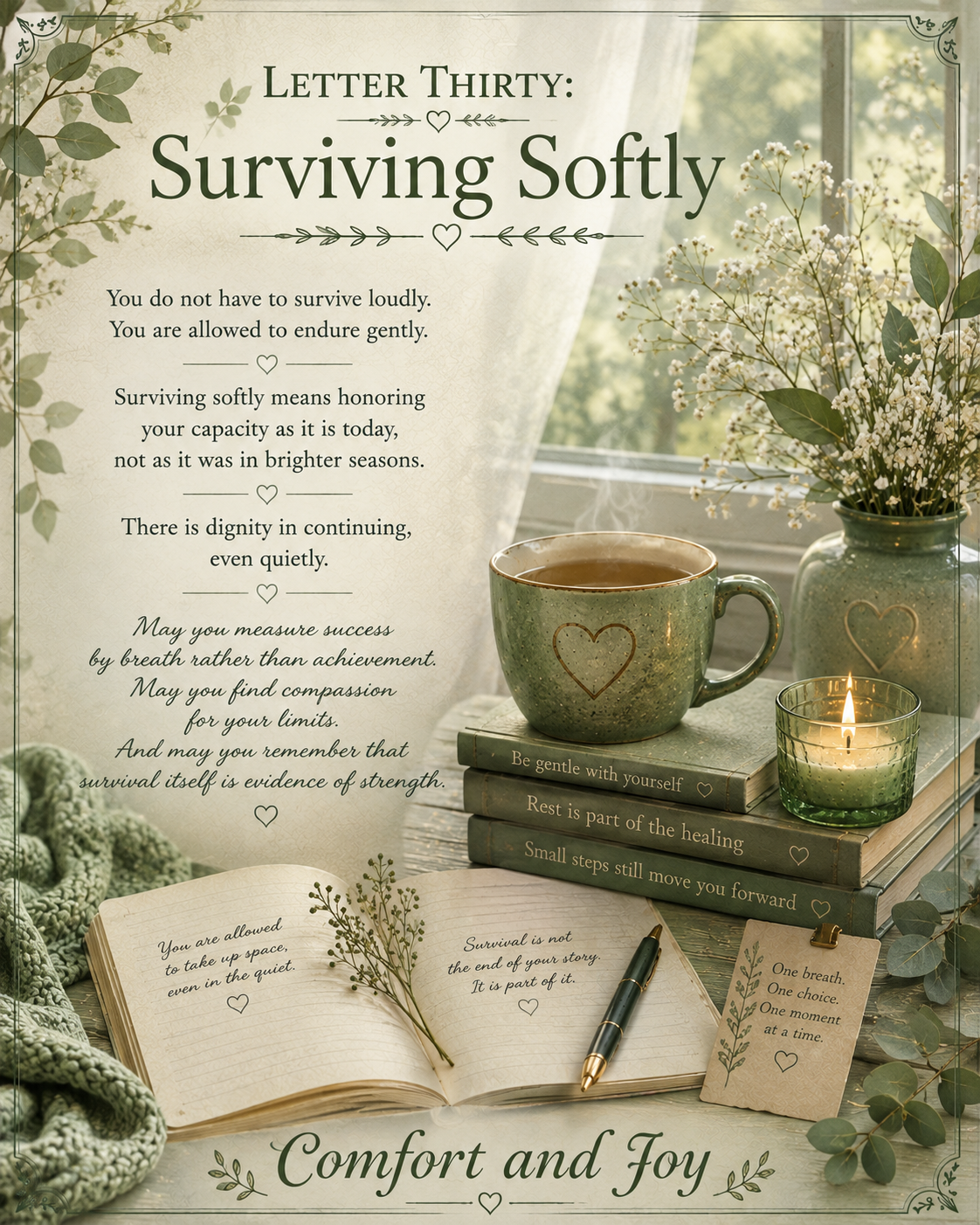
Letter Thirty: Surviving Softly

Dear Friends,

There are seasons when thriving feels distant, and simply surviving becomes the work of the day. Survival does not always look heroic. Some days, it may look like getting out of bed when grief presses heavily against your ribs. On others, it may mean answering one message instead of ten, preparing something simple to eat, or allowing the laundry to wait until tomorrow. There may even come a time when choosing rest instead of pushing harder is the bravest decision you make all day.

You do not have to survive loudly. You are allowed to endure gently.

There is a tendency to judge ourselves most harshly when we have the least to give. We remember the person who once managed everything and wonder where that person has gone. We measure today’s strength against yesterday’s capacity and mistake the difference for failure. Yet you are not failing.

Surviving softly means honoring your capacity as it is today, not demanding that it resemble what it was in brighter seasons. It means understanding that strength changes shape. Sometimes strength builds, carries, solves, and accomplishes. Other times, strength closes the door, makes a cup of tea, and decides that tomorrow is soon enough to try again.

There is wisdom in knowing the difference between surrendering and setting something down because your hands need rest. Perhaps that is one of the hardest lessons of difficult seasons: your worth does not diminish when your capacity does. You remain worthy of love when you are exhausted and when you are struggling to find your way. And this season is not your identity. The person moving slowly today still carries dreams. The heart that feels weary still remembers hope. Beneath the surface, something in you continues to endure, even when you cannot yet imagine what the next chapter will look like.

This week, if you find yourself in survival mode, treat yourself with extraordinary kindness. Make the day smaller if you need to. Take one thing at a time. Let enough truly be enough. There is dignity in continuing, even gently.

May you measure success by breath rather than achievement.
May you find compassion for your limits.
May you trust that rest does not erase your progress.

With tenderness,
Comfort and Joy

Letter Twenty-Six: Love That Shows Up Quietly

Dear Friends,

Not all love is dramatic. Rarely does it crash down on us fully formed. Sometimes, love is a whisper, a murmur. Sometimes it arrives as a tide, patient and enduring, its ever-returning certainty eroding the sharp edges of loneliness. The truth is love manifests in ways so quiet we mistake it for the background hum of living.

It is in the person who notices when you have vanished into yourself, who finds you in your silence and, rather than forcing you out, sits quietly at the threshold of your self-imposed exile. It is in the person who knows your oddest rituals—the order in which you eat an orange, the song you play when you are sad, or the way you stack your pillows at night. It is the one who notices when the light in your eyes has dulled, then returns it with laughter or the simple gift of their undivided attention.

This love will not make headlines. It will not sweep you off your feet or leave you breathless. It will simply be there, steadfast and unglamorous. It is the friend who texts merely to say they read a poem that reminded them of you, the parent who leaves the porch light on when you are late, the partner who washes the mug you always forget in the sink, then sets it right-side up on the counter because they know you hate it when the rim touches the surface.

We are told to seek love in declarations, in magic, in the tumult of newness. We learn to measure it by standards of extravagance—by how much, how loudly, and how often. But when the fireworks pass, what remains are the forms of love that persist in silence. The love that lingers at the edges of your exhaustion. The love that forgives and forgives again, never tallying the score.

Love is the person who chooses to stay when leaving is an option. It is the friend who walks beside you even when the journey is neither brief nor easy, who slows their pace so you can keep up. It is someone remembering your birthday because the date is engraved somewhere inside their rib cage.

This week, try to notice the small ways love enters your orbit. Maybe it is a dog nuzzling your calf or a child offering a dandelion. Maybe it is simply the continuity of someone showing up, again, with no agenda but your well-being.

May you learn to recognize love in its most basic forms—the understated, the wordless, the steady. May you find yourself both the recipient and the giver of care. And may you come to trust, even in the absence of spectacle, that the love which endures is the love that matters most.

With tenderness,
Comfort and Joy

Letter Twenty-Five: Being Known Without Explaining

Dear Friends,

There is comfort in being known without needing to explain yourself. To sit across from someone who understands the cadence of your pauses. Your half-formed sentences do not fall away; instead, they are gently gathered, completed with a precision that is both startling and soothing, as if the other person has been keeping watch over the scattered parts of your story, piecing them together in the soft, patient work of their own heart. Your silences are places where neither of you feels the pressure to fill the emptiness, where being together is its own answer.

So much of the world requires explanation. Every day we explain our boundaries, as if the need for space or stillness were an offense that required protection. We defend our choices, as though autonomy were a luxury, not a birthright. Emotions must be clarified, caged into words that others can safely receive. To live in the world is, in some ways, to be perpetually cross-examined by it. Every softening is a calculated risk; every vulnerability is new evidence entered into the record. Even among those who wish us well, there is often the subtle pressure to perform, to present a self that is tidy and clear.

In the presence of true connection, you are allowed to be as you are: open, unguarded, a little bit wild. You do not have to rehearse your lines, monitor your own strangeness, or worry about which version of yourself is the most acceptable to the room. All the impulse to categorize or correct falls away, and you are, for a rare and precious moment, simply received. You can laugh loudly, mourn deeply, hold opinions that contradict themselves before the ink is dry—all of this is not just allowed, but understood, perhaps even cherished. The person before you recognizes the shape of your days, the recurring motifs of your sadness and joy, the reason for your longing. They see you, with all your unfinished business and inconvenient intensity, and do not shrink from it.

If, in the vastness of your life, there is even a single place or person where you are not required to translate yourself, that is a sacred soil in which the deepest roots of your being can anchor. To be truly seen is not a rare genetic gift, but a skill that can be cultivated—beginning, perhaps, with the willingness to extend such grace to yourself. The first home of belonging is often the one you build within, the voice that meets your own uncertainties with patience, forgives the ways you fall short of your imagined self, and honors the full mess of your existence.

This week, practice showing up as you are. Notice who or what invites you to soften, who receives you with an openness that does not immediately ask you to explain or amend. Pay attention to the moments and places where your need to prove diminishes, where the air grows easier to breathe. It is in these pockets of ease that the soul recalibrates, that you remember what it feels like to be held rather than managed.

May you be known gently.
May your presence be received without condition.
And may you find belonging in spaces that feel like home.

With warmth,
Comfort and Joy