The Beauty of Being Loved for Who You Are

There is a kind of love that does not arrive with thunder or grand gestures. It does not demand to be seen. It simply is quiet, steadfast, and radiant in its simplicity. It is the love that finds you when you are not performing, when your hair is uncombed, your thoughts a little tangled, and your heart unsure of its worth. It looks at you and does not flinch. It does not ask you to be brighter, softer, thinner, louder, or more like someone else. It simply says, “You are enough.”

We spend so much of life learning how to earn affection and shrinking to fit inside someone’s idea of beautiful. But the truest kind of love has no checklist, no conditional clauses. It does not wait for you to change. It begins with who you are now, and it whispers: stay.

There is quiet beauty in that. The beauty of being loved not for what you could become, but for what already blooms within you.

The love that sees you—truly sees you—does not shout. It hums softly in the background, like a melody you almost forgot. It is in the way someone remembers the story you told months ago, or how they know your silence isn’t disinterest, but reflection. It is the warmth of being held without being fixed. The ease of being known without needing to explain. It is the moment when someone looks at you and they see you. And you realize, perhaps for the first time, that you don’t have to be extraordinary to be loved. You only have to be real.

In the stories I write, I often return to this theme—the quiet kind of love that doesn’t need to announce itself. The love that happens between the words. It’s in the way one character traces the freckles on another’s arm, as if reading constellations. It’s in the pause before a confession, the held breath that carries more truth than a thousand declarations. It’s in the way they say nothing—and yet, everything is understood.

Romance, at its heart, is not always about passion that sets the sky on fire. Sometimes it’s the gentle warmth that lingers long after the sun has set. To be loved for who you are is a rare gift. It is someone saying, “I see your shadows, and I am not afraid.” It is love that does not try to rewrite your story but chooses to walk within it.

And perhaps that is the most profound kind of beauty—the quiet certainty that you can lay down your armor and still be cherished. That you can be imperfect, unguarded, and yet, somehow… still enough. Because love, when it is true, is not loud. It is patient. It is kind. It does not decorate you—it reveals you.

When the world grows loud again, remember this: You do not need to earn the right to be loved. You only need to be willing to be seen. There is quiet beauty in being loved for who you are and even greater beauty in learning to love yourself the same way.

Love,

Carmen

The Weight and the Wings of Being a Woman

To be a woman today is to live between contradictions where expectations are heavy, yet dreams remain defiantly light. We are told to be everything at once: strong but gentle, ambitious but modest, self-sufficient yet nurturing. We are taught to rise—quietly, gracefully—while balancing the world on our shoulders.

From the moment we open our eyes each morning, the invisible choreography begins. We work, we care, we plan, we mend. We measure ourselves against impossible mirrors—society’s standards, our family’s hopes, our own hearts’ whispers. Yet behind every polished smile is a woman who fights daily battles no one sees: the fatigue that comes from trying to be “enough,” the small heartbreaks of being misunderstood, the silent rebuilding after every storm.

Still, we dream. We dream of a world that sees us for who we are, not what we’re expected to be. We dream of building careers that fulfill us and homes that comfort us without having to sacrifice one for the other. We dream of walking through life unapologetically, our worth not defined by roles or titles but by the quiet fire in our souls.

The truth is that womanhood today is both an evolution and a revolution. It’s the courage to speak when silence is safer. It’s choosing rest when the world demands productivity. It’s daring to love ourselves fully, even when the world profits from our insecurities.

Every woman carries her own story—a mosaic of efforts and small victories. We may stumble beneath the weight of expectation, but we rise, again and again, because we are not made of fragility. We are made of endurance, empathy, and a fierce, unrelenting hope. And in that daily fight—to make it, to matter, to dream—we are rewriting what it means to be a woman in this world.

Love,

Carmen

The Timeless Art of Letter Writing

Dear Readers,

The other day, I contemplated on how the world we live in is filled with texts, emojis, and video calls, and the art of writing letters seems like a relic of the past. Yet, across centuries and cultures, letters have served as one of humanity’s most powerful ways to connect, inspire, and remember.

Long before the tap of a keyboard, messages traveled the world in ink and parchment. As far back as 500 BCE, Persians, Romans, and Egyptians sent messages written on papyrus scrolls. These weren’t casual updates but were part of trade records, politics, and personal affairs. During the medieval era, monks illuminated manuscripts with gold leaf and careful calligraphy, turning letters into works of art. Royal courts exchanged diplomatic missives that could start or stop wars. During the age of exploration, letters became lifelines across the oceans. Sailors wrote home from distant ports, their words carrying tales of adventure and longing to families who might not see them for years. During the Victorian era of the 19th century came the infamous love letters, a genre of writing that was intermingled with devotion and a whole lot of hope.

While today’s communication is faster, something is often lost in the rush. A letter slows us down and invites reflection. When you write by hand, every word is chosen with more care, every sentence shaped for the reader in mind.

Letters can be keepsakes because a text can be deleted in a swipe, but a letter can be folded, tucked into a drawer, and rediscovered years later. They are time capsules because they capture not only words but also the emotion and handwriting of a moment in time. In an age where attention is scattered, a letter says, “You mattered enough for me to stop, sit, and write to you.”

Writing a letter can be transformative. For the recipient, receiving a letter in the mail is like opening a gift; it’s tactile, personal, and full of human warmth. So, pick your favorite tools, be it a simple notebook, a fountain pen, or a piece of cute stationery. Write to share memories, ask questions, and let your personality shine. Don’t worry about perfection. The real beauty is in the authenticity, not in flawless grammar. Send it, even if it feels small. A short note can have a bigger impact than you think.

Letters are bridges between hearts, woven in ink. In an era where most messages vanish in seconds, a handwritten letter can become a lasting treasure. The art of letter writing isn’t lost—it’s simply waiting for us to pick up a pen and let it live again.

Beyond the Ping

In a world flooded with pings, previews, and instant replies, we’ve never communicated more—and yet, rarely do we connect. We abbreviate emotions into emojis, reduce stories to 10-second clips, and measure relationships in likes and read receipts. But deep down, something in us longs for more than the quick tap of a thumbs-up. We crave something lasting, something true.

That something is the written word.

Reading—whether a letter, a novel, or even a well-crafted passage—invites us to slow down, to linger. It’s not just about absorbing information but about experiencing a world. Unlike text messages, which are designed for speed, written stories ask us to pause, breathe, and reflect. They open doors to inner landscapes, where thoughts echo, hearts stir, and time bends.

In stories, we meet characters who bleed with honesty. We explore wildflower meadows under silver moons, stand at the edge of ancient forests, or travel through memories too fragile to speak aloud. Through each word, we remember who we are—not the curated version but the soul beneath the surface. That’s the power of the written word: it roots us, uplifts us, and gives voice to what we’re often too busy to say.

In reading, we rise above the noise. We enter a sacred conversation between writer and reader, where empathy grows, imagination soars, and healing begins.

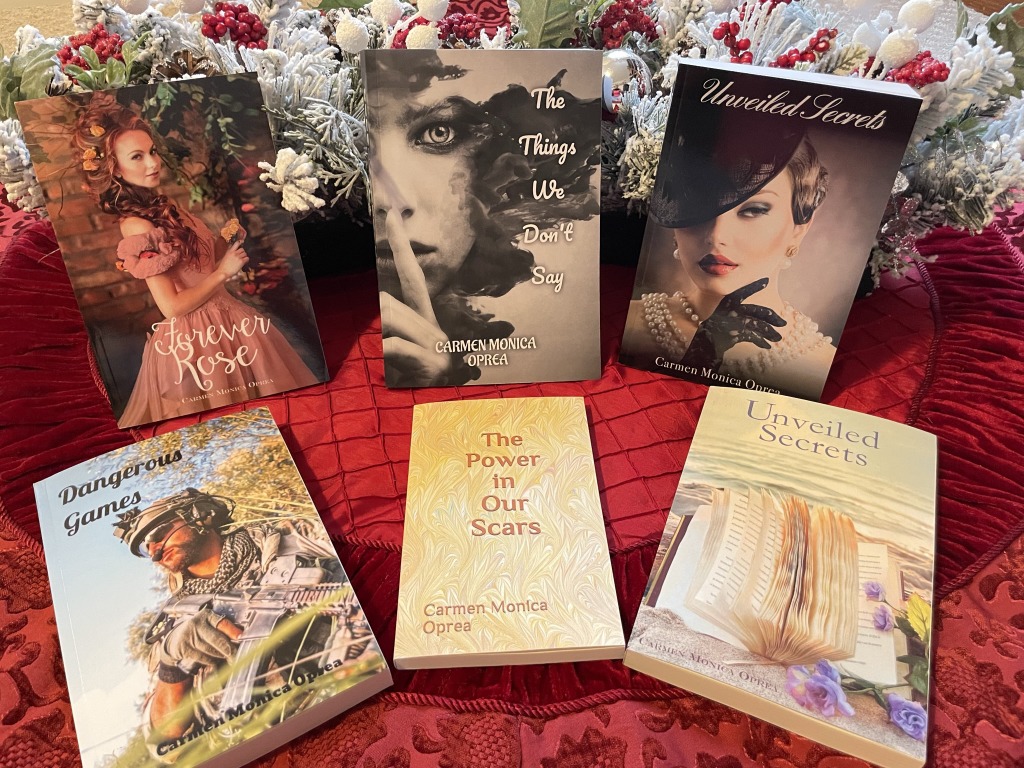
At my Amazon page, I believe in bringing that magic back—one whisper and one story at a time. This isn’t about nostalgia. It’s about revival and choosing depth. So, the next time your spirit feels tired or tangled, don’t reach for your phone. Reach for a page. Let it remind you that you are more than just a status update.

You are a story. And stories are meant to bloom.

Love,

Carmen